
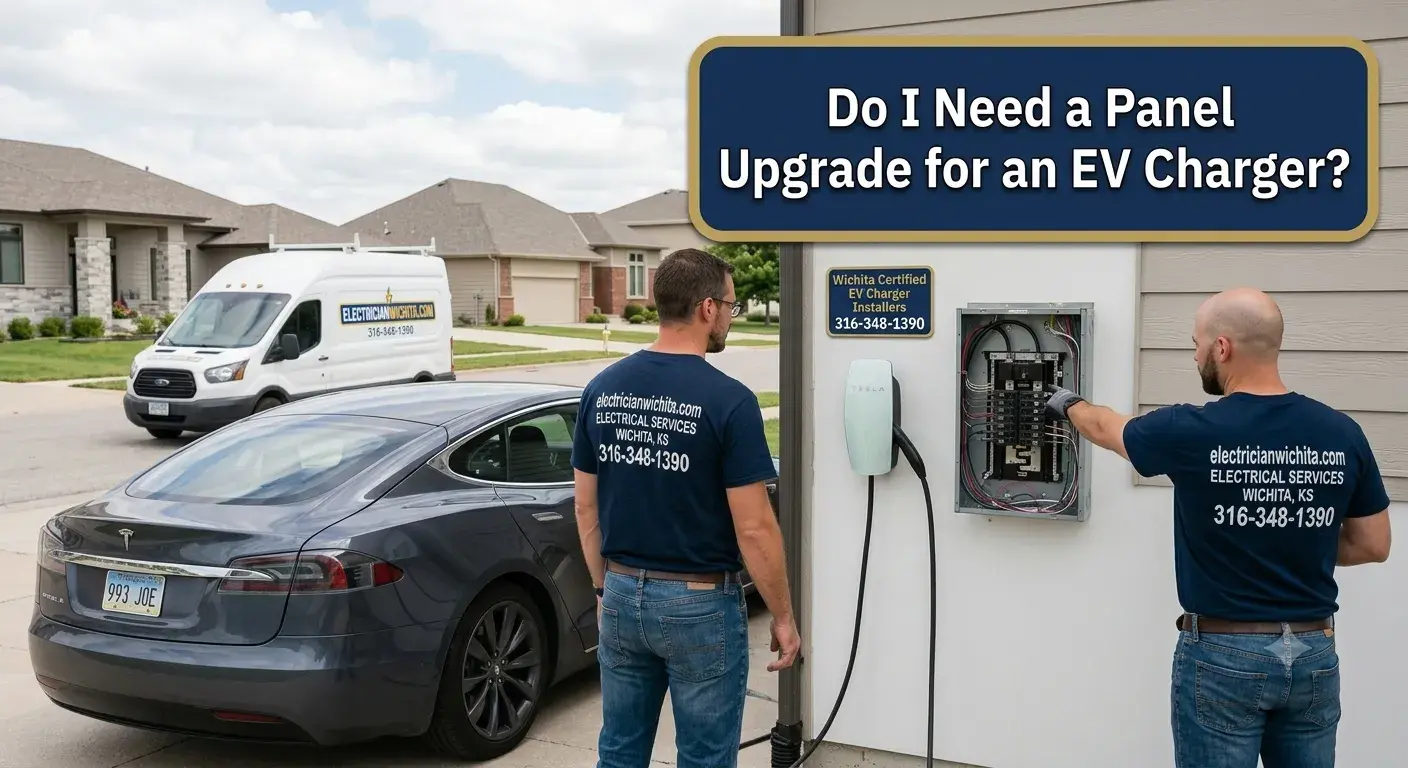
Do You Need a Panel Upgrade for an EV Charger in Wichita?
You just got an electric car, or you're about to, and you want to charge it at home. Smart move. But then an installer takes one look at your panel and says you need a $3,000 to $5,000 upgrade before they'll touch it. Ouch. Is that actually true?
Here's the honest answer that a lot of companies won't lead with: most of the time, no. A big chunk of Wichita homes do not need a panel upgrade for an EV charger at all. Let me walk you through why, and how to know where you stand.
First, What a Home EV Charger Actually Needs
A home charger comes in two flavors. Level 1 just plugs into a regular wall outlet and trickles in about 3 to 5 miles of range per hour. Fine in a pinch, painfully slow otherwise.
Level 2 is what most people want. It runs on a dedicated 240 volt circuit, the same type your electric dryer uses, and adds roughly 20 to 30 miles of range every hour. Plug in at night, wake up full. The catch is that a Level 2 charger needs its own circuit, usually rated 40 to 60 amps, and your panel has to have room for that on top of everything else your home already runs.
That word "room" is the whole ballgame here.
Why Most Wichita Homes Don't Need a Panel Upgrade for an EV Charger
Here's the part the upsell crowd skips. Your panel size, whether it says 100 or 200 amps on the main breaker, is the maximum your home can pull at once. But almost no home ever comes close to that maximum. Research shows that the vast majority of homes rarely draw anywhere near their full capacity, and most sit well under half of it at any given moment.
That matters because a lot of Wichita's homes, especially anything built after about 1990, already came with a 200 amp panel. And a 200 amp panel almost always has plenty of headroom for a Level 2 charger. Industry data backs this up: roughly 70 to 80 percent of homes with a 200 amp panel can add an EV charger without any upgrade at all. So if you're in a newer home in a place like West Wichita, Northeast Wichita, Andover, or Derby, odds are good you already have what you need. You likely don't need a panel upgrade for an EV charger.
That's real money saved, since a full panel upgrade runs $1,500 to $3,500 or more, while just adding the charger circuit is often $500 to $1,500.
The Honest Truth About Upsells
I'm going to say the quiet part out loud. There's a reason some installers are quick to recommend a panel upgrade for an EV charger. A company makes a lot more on a $3,000 upgrade than on a $500 circuit pull. It's not always a scam, but the incentive is real, and it leads to a lot of upgrades that a simple calculation would have shown were unnecessary.
The way to protect yourself is easy. Before you agree to anything, ask for a load calculation. A licensed electrician tallies up your home's square footage and major appliances, using the National Electrical Code method, and figures out exactly how much spare capacity you've got. That number tells the truth, and it usually shows more room than people expect. If someone recommends a panel upgrade for an EV charger without doing that math first, get a second opinion.
When You Actually Might Need an Upgrade
Now, I'm not going to pretend every home is fine. Some genuinely need work, and that's usually about 20 percent of homes. Here's when a panel upgrade for an EV charger really does make sense.
You have an older 100 amp panel and your home is loaded with electric appliances, central air, an electric dryer, an electric water heater, an electric range, all pulling hard. Add a charger on top and you can push that panel past its safe limit. This is more common in Wichita's older neighborhoods like College Hill, Riverside, and Delano, where 100 amp service is still around.
You have an old 60 amp panel or a fuse box. That's not enough for a modern home plus a charger, full stop. An upgrade is the safe call.
Your panel is physically full, with no open slots for a new breaker. Or you see warning signs already, like breakers tripping when big appliances run, flickering lights, or a warm or damaged panel. Those mean your panel is struggling before you even add the car.
In these cases, a panel upgrade for an EV charger isn't an upsell, it's the right move for safety.
You Have Options Besides a Full Upgrade
Here's more good news. Even if your panel is a little tight, a full upgrade isn't your only path. A licensed electrician can often get you charging without replacing the whole panel.
A load management device is the clever one. It watches your home's power use and automatically pauses or slows your car charging when heavy appliances kick on, then resumes when they shut off. This keeps you under your safe limit without a costly upgrade, and these devices cost a fraction of a panel replacement.
A subpanel is another option. If your main panel has enough amperage but just ran out of physical space for a breaker, a subpanel adds slots without touching your service size. And you can simply run a lower amperage charger, say 24 or 32 amps instead of 48. It charges a bit slower but still fills your car overnight, and it fits comfortably in a tighter panel.
The point is, a good electrician looks for the smart, affordable path first, not the priciest one.
What About Permits in Wichita?
Quick but important. In Sedgwick County, installing a Level 2 EV charger requires a permit, and there's an inspection when it's done. A proper licensed electrician pulls that permit through MABCD, handles the inspection, and takes care of any utility notification. Don't skip this. Permitted, code compliant work keeps you safe and keeps your home insurable.
There's also a nice bonus. A federal tax credit covers 30 percent of your home charger installation cost, up to $1,000. Worth grabbing.
The Bottom Line
If you're getting an EV in Wichita, don't let the first "you need an upgrade" scare you into a big check. Most homes, especially newer ones with 200 amp service, do not need a panel upgrade for an EV charger. The only way to know your situation for sure is a proper load calculation from a licensed electrician who'll give you the honest math, not just the expensive answer.
Get that number first. Then charge with confidence.