
What Size Generator Do I Need for My Wichita Home?
If you've lived through a Kansas ice storm or a summer wind event, you already know the drill. The power goes out, and you're suddenly counting hours in the dark, hoping the food in the fridge holds and the basement stays dry. A standby generator ends that worry for good. But before you buy one, there's one big question to answer: what size generator do I need?
Get the size right and your home hums along like nothing happened. Get it wrong and you either trip the generator constantly or waste money on power you'll never use. Let me break it down in plain terms.
First, Decide What You Want to Keep Running
Sizing a generator starts with a simple choice, not a math formula. Do you want to keep just the essentials on, or run your whole house like normal?
Essentials means the stuff you can't do without. The refrigerator and freezer so your food doesn't spoil. A sump pump so your basement doesn't flood during a heavy Kansas rain. The furnace blower so you stay warm in a winter outage. A few lights, and maybe a well pump if you're not on city water. This keeps you safe and comfortable without powering every outlet.
Whole home means everything runs like the power never went out. Central AC, the full kitchen, the home office, all of it, automatically. It costs more, but you don't change a thing during an outage.
Your answer to that question shapes everything else, so it's the first thing to settle when figuring out what size generator do I need.
The Quick Answer: Generator Sizes by Home
Alright, here are the ballpark numbers most Wichita homes land on. Generators are measured in kilowatts, or kW.
For essentials only, a 10 to 14 kW unit usually does the trick. That covers the fridge, sump pump, furnace, and lights for most homes.
For whole home coverage, you're generally looking at 16 to 22 kW, and often 20 to 24 kW for a typical Wichita home that wants the central AC running too. Air conditioning is usually the single biggest power draw, so if you want it on during a July outage, you need to size up for it.
For larger homes, over 3,000 square feet, or homes with electric heat, dual AC units, or an EV charger, you may need 24 kW or more. As a rough guide, add about 5 kW to your number if you have electric heat or want to charge an electric car during an outage.
So when someone asks me what size generator do I need, the honest starting point is: somewhere between 14 and 24 kW for most Wichita homes, depending on whether you want essentials or the whole house.
Why Kansas Weather Pushes People Toward Whole Home
Here's where our local reality matters. Wichita doesn't get gentle outages. Ice storms can snap lines and leave whole neighborhoods dark for days. Summer wind and thunderstorms knock power out too, right when the heat is brutal and you really want that AC.
Because our outages can drag on, a lot of Wichita families lean toward whole home coverage rather than bare essentials. Nobody wants to sweat through a three day July outage or huddle around space heaters in January. That storm season reality is a big reason folks here ask what size generator do I need in the first place, and why the answer often trends bigger than in milder parts of the country. A properly sized standby unit runs on natural gas or propane and can keep going for days, even weeks, as long as it has fuel.
The Real Way to Size It: A Load Calculation
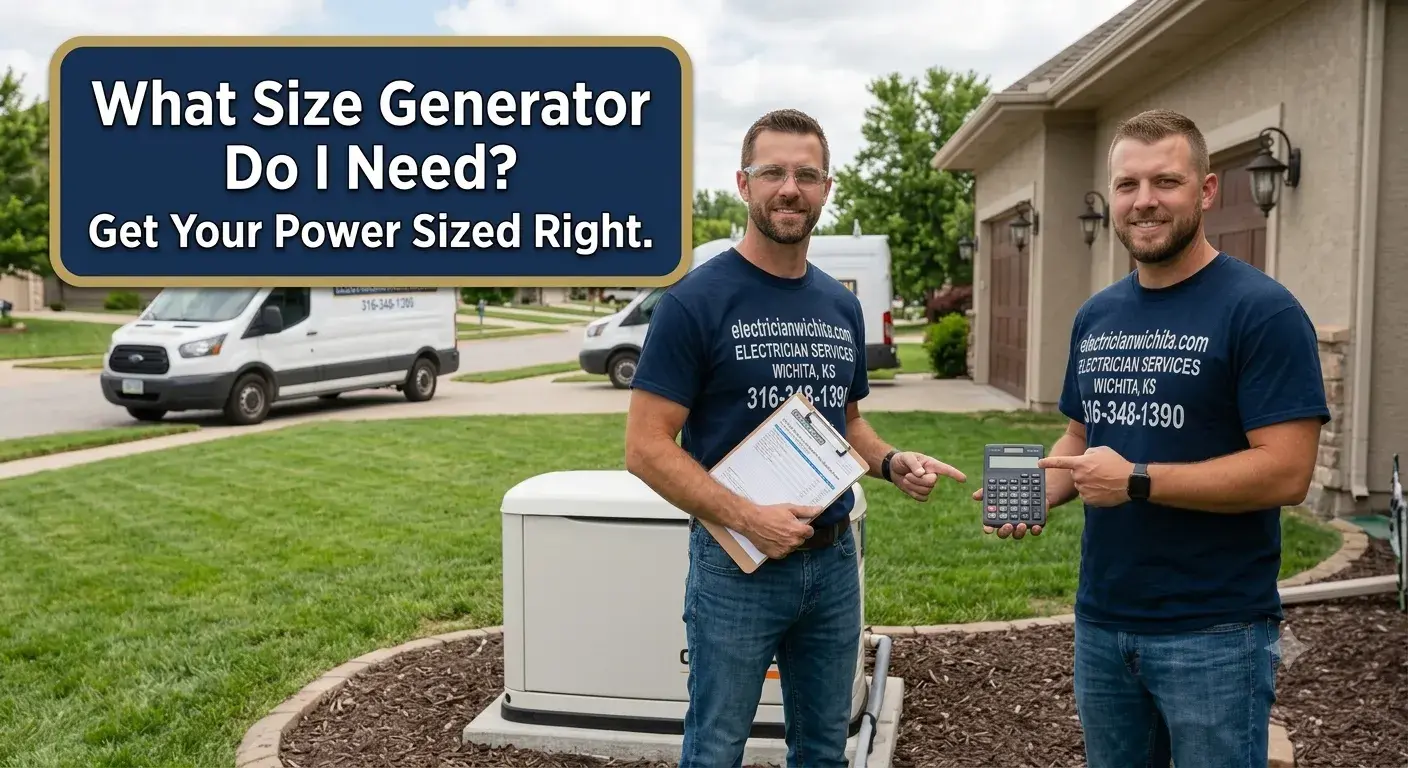
Those ballpark numbers are a great starting point, but I'll be straight with you. The only way to nail the right size is a proper load calculation, and that's a job for a licensed electrician.
Here's the basic idea behind it. You add up the running watts of everything you want to power at once. Then you add the starting surge of your single biggest motor, usually the central AC or a well pump, because motors pull extra power for a couple seconds when they kick on. Then you tack on a safety buffer of about 20 percent so the generator isn't maxed out. That final number tells you the right kW size.
Why not just guess big to be safe? Because an oversized generator wastes fuel and costs more than you need. And an undersized one won't start your AC or will trip under load. Getting it just right is the sweet spot, and that's exactly what a load calculation finds. So when you're serious about answering what size generator do I need, skip the online guesswork and get a pro to run the numbers on your actual home.
Don't Forget the Transfer Switch
One piece people overlook when sizing a generator is the automatic transfer switch, and it's not optional. Think of it as the brain of the whole system. It watches the grid, and the second power drops, it safely disconnects your home from the utility lines and starts the generator, all on its own within seconds.
That automatic part is what makes a standby generator so nice, you do nothing. It also protects utility workers, because it stops your generator from feeding power back onto the lines they're working on. Every proper standby install includes one, wired by a licensed electrician.
A Smart Trick: Load Management
Here's a tip that can save you money. Modern systems can use load management, which lets a smaller generator do the work of a bigger one. The system watches your total power use and briefly pauses a non essential circuit, say the electric dryer, when a big load like the AC kicks on, then restores it a moment later.
The result? A 22 kW generator with load management can cover what might otherwise need 30 kW. So if you're torn on what size generator do I need, load management can be the difference between buying up a size or staying comfortable with a smaller, cheaper unit. Your electrician can tell you if it fits your setup.
What It Costs, Roughly
Since it comes up right after sizing, here's the ballpark. A whole home standby generator, installed, generally runs somewhere around $10,000 to $18,000 or more, depending on the size, your fuel setup, and site work like the concrete pad and permits. Bigger homes with larger units run higher. It's a real investment, but for a home in an outage prone area, a lot of Wichita families decide it's worth every penny the first time a storm rolls through and they never even notice.
The Bottom Line
So, what size generator do I need? For most Wichita homes, plan on 14 to 18 kW if you just want the essentials, and 20 to 24 kW if you want the whole house running with the AC on. Bigger if you've got electric heat, a large home, or an EV to charge.
But those are starting points, not gospel. The smart move is to have a licensed local electrician run a real load calculation, size it right, and install it with a proper transfer switch. Do that before storm season, not during it, and you'll never sweat a Kansas outage again.